Wednesday, December 13, 2006

DHS Raids Likely Part of Bush Political Strategy

This week the Department of Homeland Security (DHS) and Immigration and Customs Enforcement (ICE) raided meatpacking and poultry plants around the country arresting some 1,300 workers for alleged immigration violations and identity theft. If, as it appears to be, this is the start of a generalized crackdown on undocumented workers, we could be witnessing the largest mass deportations since the 1930s when local and federal officials indiscriminately rounded up Mexicans and Mexican Americans (including citizens) and sent them south of the border.

One of the major employers in this round up, the meatpacker Swift, has not been charged with any crime, although it seems unlikely that they would not have known what was up with their workers.

As the Washington Post reported, this move by DHS is likely part of the administration's strategy to put pressure on Congress to pass immigration "reform."

Stepped-up raids across the country, not just near the U.S. border with Mexico, could be an effort to pressure Congress to overhaul an immigration system widely seen as needing urgent repair, said Deborah Meyers, a senior policy analyst at the Migration Policy Institute, a Washington think tank.

Immigration reform is a priority of President George W. Bush, but overhaul attempts have so far foundered in Congress.

Advocates of tougher immigration enforcement welcomed the coordinated raids, and said more were needed.

"Everyone agrees that the centerpiece of immigration enforcement has to be at the workplace, so it is good to see that they are doing this," said Steven Camarota of the Center for Immigration Studies in Washington.

Union officials condemned what they saw as an unnecessarily rough raid and for singling out Latino workers.

"We're trying to criminalize the real victims here, who are just trying to find a better life," said Mark Lauritsen, a United Food & Commercial Workers International Union officer.


The PBS News Hour interviewed Lauritsen from UFCW and Julie Myers from ICE, which is remarkable in that you almost never hear labor reps on this show (I listen to it on the radio). Predictably, the interviewer focused on the "threats" of undocumented workers and identity theft. Lauritsen to his credit tried to deflect the discussion away from criminalizing his membership. He's walking a fine line. It's more than a marginal possibility that many of these workers are undocumented. But the union represents the workers regardless of legal status. He focused on how the pending deportations split families, citing cases where both parents worked in the plant and were arrested so the children could not be released from school at the end of the day.
GWEN IFILL: But let me ask you this. These family and communities, would you agree that many of them were here illegally and, therefore, working illegally?
MARK LAURITSEN: We don't know that; we don't know what their status was. What I know, as a representative of people that work for a living, is that, if they're employed where there's a collective bargaining agreement, I have a job, and our local unions have a job to represent them, regardless, and that's what the law says. Regardless of any documentation status, I represent them.
GWEN IFILL: So it's up to the company to determine whether these people are working legally or not?
MARK LAURITSEN: What has happened with these workers, though, is that all their representation was stripped away from them by the immigration folks. They came in, and these folks have been shipped to parts of this country unknown. Their family members do not know where they are. And they've been denied the basic right in this country of representation, which could have came from our representatives or it could have came from the attorneys that we had on site willing to represent these folks.

Naturally, this logic is like a foreign language to the interviewer. And although it is not the most forceful statement of "labor rights are human rights," essentially the union is saying asserting that their right/duty to represent should trump ICE's right to deport.

Lauritsen also made in interesting and somewhat troubling appeal to history:
MARK LAURITSEN: I don't know about the [workers' lack of] documentation; I know about the meatpacking industry. Throughout its history, it was built on immigrant workers. The industry has always relied on the immigrant workforce, be it the Polish, the Danish, the Italians that did it earlier in generations, and it's always going to be an immigrant workforce that does that.
He's walking a fine line. How much can you get across in a brief interview? On the one hand, he's trying to defend the right of his members, who may be undocumented, to work in the industry. On the other hand, this kind of appeal to history suggests that, if the meatpacking workforce has always been immigrant, then it has also always been low-wage. The workforce, has not always been immigrant. It has also consisted of rural migrants (black and white) from the American countryside. He could have added that earlier generations of packinghouse workers organized a militant union that actually raised wages and improved conditions.

These complexities are part of the key to why the children and grandchildren of the previous generation of packinghouse workers in the midwest and west are uneasy about the newcomers. It is not the fault of new immigrants that the wages are low. The decline of wages and conditions began as the business strategy of so-called "New Breed" packers like IBP in the 1980s, and migrated to the unionized packers as the New Breed undermined the profits of the old line packers. Now the old and new have merged, and the industry is once again dominated by very large corporations like ConAgra and Cargill who are happy to benefit from the low wages pioneered by the New Breed.

Without this context, is it surprising that communities sometimes blame new immigrants for their own plight?

Friday, December 08, 2006

Haymarket Gallows, Believe It Or Not

A few months ago, one of my students alerted me to the fact that the gallows used to hang the Haymarket Martyrs was going up for auction. The structure was built in 1887 specifically to accommodate the convicted anarchists, and was later used by Cook County to execute a number of convicted murderers (One presumes that those who came after the martyrs actually did murder someone, but given the record of the Chicago police on forced confessions, I'll leave it to someone who knows the facts of those cases to make the judgement). In the 1970s, the county sold the gallows to a theme park in--of all places--Union, Illinois. The gallows went on the auction block along with lots of sports memorabilia for a minimum bid of $5,000.

The auction of the gallows generated some interesting discussion in class. My initial thought was--buy it and burn it. But others suggested that it could serve as a useful educational artifact, as long as it landed in the right hands and was surrounded by the good interpretation. Several Chicago unions and the Illinois Labor History Society apparently discussed the idea of bidding for the gallows, and the Chicago Historical Society (a.k.a., the Chicago History Museum) actually made a very big bid. But in the end, the successful bid came from the corporate "museum" chain "Ripley's Believe It Or Not." See the Sun-Times a report, and Mastro Auctions for the details. The final bid was more than $50,000.

In an email to board members of the Illinois Labor History Society, Larry Spivak of AFSCME wrote:
As some of you know the gallows constructed and used to execute the Haymarket Martyrs and subsequently all others convicted to die by hanging in Cook County until 1927 was recently auctioned off by a private owner. I have been discussing this matter with the Chicago History Museum who made a very large bid for the item. Unfortunately, the deep pockets of corporate America won out. Believe it or not, I'm not joking, Ripley's Believe It or Not museum chain out bid our friends at the Chicago History Museum. It went for over $50,000. Sadly, we should not expect this important symbol to be properly represented historically or otherwise.


In fact, the newspapers quoted the buyer for Ripley's to the effect that what really interested them was the story of the last man slated for hanging on the gallows. The convicted murderer escaped before his appointment with the rope and was never found. That is their "believe it or not."

Tuesday, December 05, 2006

New Mexican President's "Dialogue" Looks a Lot Like Repression

Well, that didn't take long. Felipe Calderon was just sworn in as President of Mexico on December 1st with lots of talk about reaching out to his opponents to create dialogue, but also a "firm hand" against criminals.

If there was any question about how the new president of Mexico would deal with the social movement in the southern state of Oaxaca, the answer is now crystal clear. Acting on warrants from state courts in Oaxaca, last night the federal government arrested Flavio Sosa, a main leader of the APPO (Popular Assembly of the Peoples of Oaxaca) and one of his brothers while they were in Mexico City. The arrests came just two hours after APPO announced it had made first contacts for dialogue with the Calderon government, according to La Jornada. They are charged with, among other things, kidnapping, arson, and sedition. After their arrest, the Sosa brothers were shipped off to separate federal prisons. Flavio is in a maximum security prison.

Meanwhile the rest of APPO's leadership has gone underground. In a message delivered from "somewhere in the state of Oaxaca," the APPO calls for a mass meeting in Oaxaca City on December 10th. This document is translated on the NarcoNews site:
The APPO is more alive than ever in the hearts of the workers, indigenous people, campesinos, housewives, students, youth, children, and all the exploited and oppressed in Oaxaca and Mexico. The State Terror that has been unleashed on the people of Oaxaca and the international community with increased brutality since November 25 has not weakened our desire to be free men and women.

Nor has it made us change our minds about whether our struggle should continue to be a political, peaceful and mass movement, despite the fact that 17 people have been killed during this stage of the struggle, dozens of people have disappeared and hundreds are political prisoners; we consider this toll to consist of crimes against humanity.

And speaking of NarcoNews: they have put out an urgent appeal for donations. The laptop of their lead reporter crashed and he has been unable to coordinate reporting. You can donate any amount of money to their "Fund for Authentic Journalism" online via PayPal. Go for it!

Thursday, November 30, 2006

Meet the New Boss, Same as the Old Boss

At 12 midnight and one second tonight, Felipe Calderon becomes President of Mexico, whether or not he is allowed to take the oath of office before a joint session of Congress tomorrow.

Suggested reading:

The Coup d'Etat in Mexico

Oaxaca: The End of Tolerance

Tuesday, November 28, 2006

Oaxaca and New Media, Again

My readers will forgive me for being a bit behind the times: I've just discovered YouTube. Yes, I'm sure there's a lot of crap on it. But what is really interesting to me is how the images of the social conflict in Oaxaca are being repackaged, set to music, and sent out into the world with a very conscious message of international solidarity and organizing.

Todos Somos Oaxaca, to quote the title of one video--which was embedded in the home page of the southern Mexico newspapger Por Esto! this morning. This is set to a spanish-language hip-hop tune with the refrain "You won't fail if there's a beginning." A similar video montage is set to an English-language punk/hip-hop tune--"renegades of the atomic age"--that invokes the "renegades" of various ages--Tom Paine, Martin Luther King. Another is set to the music of Nirvana's "Smells Like Teen Spirit." Not a song I grew up with, but one my slightly younger spouse tells me was the "Twist and Shout" of her cohort.

What fascinates me about these videos--beside their visceral intensity, clever juxtaposition of image and sound, and powerful presentation--is that they are both artifacts of globalization and of an emergent counterhegemonic movement against neoliberal globalization. The reach of American muscial culture is evident. But two of these videos move from images of Oaxaca to protests in support of APPO in Europe, South and North America. The message emblazoned on the frame: what can you do to help us? Join us.

This past weekend there was a new, more intense round of violence in Oaxaca as Federal Police broke up a very large, and peaceful march. Nearly 150 people were arrested and flown to prisons in other states. NarcoNews reports that prisoners have been tortured. But almost nothing in the US press.

Saturday, November 11, 2006

Local Struggles, Global Symbols

The American election results made the headlines in Mexico, even if US media have for the moment forgotten not only about Oaxaca, but the rest of the world as well. Cautiously welcoming the Democratic victory, Mexicans hope for a more nuanced, less strident discussion on immigration and "border security."

No doubt there will be a change in tone from the US Congress. The Illinois Coalition for Immigrant and Refugee Rights (ICIRR), cheers the election as well, headlining: "IMMIGRATION FAILS AS WEDGE ISSUE FOR GOP" citing a survey of election results from Immigration 2006.
"Our preliminary analysis of last night’s results strongly suggest that very few toss up races were won by Republican candidates who attempted to exploit immigration as a voter motivator. Democrats that back comprehensive immigration reform mostly won their races. And the Republican Party is likely to get smaller as its hard line on immigration drives away Hispanic voters."
A bit over optimistic to my way of thinking. But the new political landscape in Washington will make a difference. We will probably see the new leadership move to pass the previously-stalled "comprehensive" reform package that includes amnesty for some, deportation for more than a million, and a guest worker program that will cycle millions of disenfranchized workers in and out of the US economy. The guest worker program is favored by Bush and leading Dems (it is supported by SEIU, but opposed by AFL-CIO), so it's an obvious choice for those seeking to prove their bipartisan cred.

I am not so sure that guest workers will go down well with the American workers who just put the Dems in office, and that dynamic will be interesting to watch. Take a quick look at what union folks are complaining about at the Fox Valley Labor News: the spectre of a Canada-US-Mexico superstate that would throw out the US Constitution. This conspiracy theory is being pushed by a group of ultra-right wingers, and it came up among a group of Steelworkers I taught last summer.

If the Democratic leadership simply pushes the Kennedy immigration bill for swift passage, I think it will backfire. Instead, the Dems would be wise to foster an honest dialogue on immigration, free from the shrill racism, jingoism, and demogogery of the last few years. After that, maybe we can have new laws, new programs.

Back in Oaxaca, the fire burns on and Ulises Ruiz's hold on office gets more tenuous. No doubt he's just holding on until December 1st. If he resigns before then, there will be a new election--which the PRD will probably win. After December 1st, the PRI-PAN alliance can name a replacement.

There is a very nice analysis by Laura Carlson of the International Relation Center that takes in the whole situation and its relation to neoliberalism, free trade and globalization. This is one of those rare articles that is measured, historically informed, and forward looking. And this is what inspires the title of my post:

If the movement for global justice were a territorial battle, Oaxaca would be a tiny point on a very large map, of little consequence except to the people involved. But symbolic battles, although very real for the combatants themselves, are the true terrain of the movement for global justice. They offer an opportunity, even when lost, to defeat the myths that uphold the system.

And why does this strike me so today? Because I'm reading James Green's excellent new book on nineteenth century American class society, Death in the Haymarket so I can teach it to a group of union leaders. (If you need a quick version of the Haymarket story, go to the Encyclopedia of Chicago). As a historian who lived in Chicago for five years, I have to admit I had grown a little tired of Haymarket. After a few hundred retellings, it gets old. But if it lost something in the telling, the story has always captured something visceral in me whenever I have encountered one of the spaces and memorials of the event.

Green sets the story of the bombing in Chicago's Haymarket Square on May 4, 1886, within a rich context of immigrant working class life and class warfare that took on an intensely personal character even as it symbolized wider struggles. The Chicago anarchists certainly understood the symbolic, and they saw themselves as part of a trans-Atlantic, if not quite global, movement. And ironically, over time the Chicago martyrs became much more known outside of the US than they were inside.

haymarket_police.jpg

As Oaxaca is today, Chicago in 1886 was a local conflict on the cutting edge of "globalization." A very different form of globalization, and a different form of struggle, but both are local struggles with global symbolism.

In a sense, the two came together last May 1st when a huge march of immigrants--largely Mexicans and other Latin Americans marched through Haymarket Square. The new, powers-that-be-approved memorial wasn't the focus of the march, as it was of the CFL-sponsored labor day rally later the same day. But it was also more than just something passed along the way. The organizers clearly understood the symbolism of May 1st, and they chose their path to connect their struggle with the Chicago martyrs.

These are my rather jumbled thoughts on this, November 11, the anniversary of the hanging in Chicago of Albert Parsons, August Spies, Adolph Fischer, and George Engel in 1887.

Tuesday, November 07, 2006

The Oaxaca Movement and New Media

Nancy Davies has a very interesting analysis of the impact of new media on the social movement in Oaxaca in the NarcoNews Bulletin. In brief, widespread use of digital cameras, independent online sources like NarcoNews, LaJornada, and others, and the APPO's ability to hang on to control of Radio Universidad has closed off many of the traditional strategies of the repressive PRI governor. As independent news sources persist and proliferate, it becomes impossible for the governor to use agents provocateur, and to blame state-sponsored violence on the movement.

An excerpt:
In addition, camera and video brigades, of foreign and national journalists, have arrived in force. Everything gets shown, leaving the PRI and URO with no place to hide. Local movement people carry cameras and when an attack is threatened Radio Universidad sends out a call for everybody to come with video cameras and still cameras, to document what is happening –as they did with the June 14 attack on the zocalo. Each helicopter overhead shows up in a photo. URO’s ability to lie about who has the weapons and who shot whom, has been destroyed. Every video and every still, furthermore, finds its way onto the internet, the international news, the national news, the local news –all the way down to the streets where the videos play on screens perched on boxes on the sidewalk, for every passerby to see.
This, as much as anything, explains why the PFP wanted to close down Radio Universidad. And their failure may signal the end for Ulises Ruiz and the PRI precisely because it was captured by independent media and is being replayed again and again on the streets of Oaxaca and across the globe.

Friday, November 03, 2006

PFP Attacks University in Oaxaca

I was out of touch for one day and lots has happened. Just some quotes from other sites, since there's no time to summarize--have to cut my 20 page paper down to 10 in the next hour and a half.

From Nancy Davies
The War is On in Oaxaca

Posted on Thu Nov 2nd, 2006 at 01:06:16 PM EST
The war is on in Oaxaca. It began at 8:00 AM with the gathering of the PFP and an infiltration by porros (hired thugs) along with state police in plain clothes. There are 5,000 PFP and many people if they're out there. The Rector of the university has called for unity and denounced the federal gov't. The University is an autonomous community. The radio is calling for pacific resistance but since the feds are using tear gas the people are pissed off and the report is that they are starting to use rocks and sticks. Several people have been arrested and wounded, including three children. A helicopter is there and presumably may airlift people to the airport for getting them into custody.
According to George Salzman, later in the morning as PFP confronted ranks of mostly young male protesters, the protesters threw rocks, homemade missiles and molatov cocktails at the police:
When one of the projectiles hit the ground and burst into flame in front of the first line of troops a wave of adrenaline swept the protesters, many of whom ran forward and hurled rocks at the police. I’ve written a lot about the teachers and APPO maintaining a militant but non-violent struggle, which I remain convinced is correct. But this was a different matter: this was people trying to protect their own turf from being invaded by lethally-armed forces, and there’s no way the attempted defense could be described as non-violent. Had the police been ordered to shoot, it could have been a massacre. All that can be said is that the imbalance of power was incomparably in favor of the police; had it been used, it would have been overwhelming.
And from El Universal/Miami Herald this moring:

Along the avenue, opposite the campus, a mid-day soccer game in progress came to a grinding halt, but the players paused only for a moment before they scurried to find rocks and join the protesters in throwing them at the police from the field.

Men and women pushed shopping carts filled with rocks up toward the front line. They shouted to those coming from surrounding streets to bring rocks. An elderly woman advanced into the clouds of tear gas offering water that had been blessed by a local priest to the students.

The police were forced back, but only to open the way for a coordinated attack by riot tanks and their water cannons - with water laced with pepper spray.

Inside the university grounds, protesters coordinated brigades to rush Coca-Cola and vinegar, their remedy for the immediate burn of tear gas, out to the protesters. Announcers inside the university radio station called for supporters to bring food, water, and Coke to the university.

The battle then turned into chaos. The PFP drove their tanks up and down to disperse the crowd; three military helicopters flew overhead firing tear gas grenades. The protesters rushed the police and the tanks with thick volleys of rocks and then ran back to take cover and wash their burning faces in Coke.

By late afternoon hundreds more had joined the protesters, pushing the police back from the university, capturing a riot tank and setting it aflame. Two helicopters flew over, dropping tear gas grenades, but too late: at 3 p.m. the PFP were in full retreat.

Late Thursday night, APPO spokesman Florentino López said 55 protesters had been detained by the PFP.

Will check in tomorrow.

Sunday, October 29, 2006

Oaxaca Takeover Begins


Developing news and on the ground reports coming in from NarcoNewsBulletin, and El Universal reports the PFP (federal police) entering the zocalo with few if any people present around 3:30 PM. The PFP is using watercannon to dispurse the crowds defending barricades, according to LaJornada.

There are great images, like this one from El Universal, showing what is going on as the PFP moves forward. It may be the presence of journalists that will restrain the troops from coming down too hard on protesters. Up to now the dealths have been at the hands of undercover PRI operatives. Although the people watch carefully, they may also wonder if the troops will prevent more PRI vs. APPO violence. For now.

According to El Universal, n the zocolo, 3:43 local time, a contingent of PFP arrived in trucks near the zocalo. The got off the trucks, and moved toward the square. Apparently, APPO members then used the trucks to block the streets--behind the troops, I assume. Hundreds of peopld form lines and chant as the troops move forward. (Alernatively, from NarcoNews, Nancy Davies reports from the zocolo that about 200 women are in the square, "some carrying long poles with white flags... The roads are blocked coming in, but people seen ready."
~~~~~~~
Update. The photo I chose, sadly, was too hopeful. The news over the last few hours includes many more of open confrontations between police and protesters. Two protesters reported dead; the police have cut APPO's last radio station off the air, and as of 8PM APPO abandoned the zocalo and the PFP took up positions there. NarcoNews passes on reports of police raiding the homes of APPO leaders.

Showdown in Oaxaca: Feds Enter City

After a weekend of violence in which undercover police and municipal officials shot and killed several APPO supporters and an American Indymedia journalist, a new turn of events is taking place in Oaxaca. Yesterday, federal police flew to the southern city and the government issued an ultimatum to APPO to clear the barricades. Newspapers showed pictures of hundreds of police loading out of a plane, carrying riot gear. See Nancy Davies on the spot reporting in NarcoNews Bulletin for details on Friday's killings.

Naturally, APPO rejected the ultimatum, and this morning (7:30AM Mexico City time) according to El Universal, the Federal Preventive Police are moving into the city center on buses. APPO is calling all its supporters to the streets, and asking them to nonviolently resist the federal police. El Universal reports that some APPO supporters are waving white flags.

Meanwhile, teachers are tentatively expected to return to work on Monday. But if something crazy goes down today that might not happen.

Sunday, October 15, 2006

More Glowing Reviews of Andy Stern from Corporate America

CNNMoney/Fortune:

"Andy is absolutely straight-up," says David Lawrence, the former head of Kaiser Permanente, with whom Stern settled a bitter, long-running labor dispute in 1997. "He's neither defensive nor paranoid and takes a pragmatic approach to solving problems."

"He's a maverick with his own mind and his own way of running things," says California governor Arnold Schwarzenegger, who invited Stern to be one of a handful of speakers at a star-studded health-care conclave he hosted this summer.

"Andy's a breath of fresh air," agrees Tom Donohue, president of the U.S. Chamber of Commerce, which is girding for a fight in the next Congress over the rules governing the recognition of unions.

http://money.cnn.com/magazines/fortune/fortune_archive/2006/10/16/8390290/index.htm?section=money_latest

Tuesday, October 03, 2006

NLRB Ruling Opens Door to More Deunionizing

The National Labor Relations Board (NLRB) issued an important new ruling today in the so-called Kentucky River case. In a nutshell, the board ruled that lead nurses are "supervisors" and therefore have no right to join a union because they assign tasks and direct the work of other employees, specifically nursing aides. Can they hire or fire other employees? No. Doesn't matter. They're supervisors.

In the words of the dissenting board members:
Today’s decision threatens to create a new class of workers under Federal labor law: workers who have neither the genuine prerogatives of management, nor the statutory rights of ordinary employees. Into that category may fall most professionals (among many other workers), who by 2012 could number almost 34 million, accounting for 23.3 percent of the work force.
The full text of the majority ruling and the dissent is at: http://www.nlrb.gov/nlrb/shared_files/decisions/348/348-37.htm

Commentary at: Working Life, AFL-CIO Now, SEIU.

Wednesday, September 27, 2006

APPO Goes National and Transnational

There is an interesting article in the Monterrey, Mex, newspaper El Provenir regarding the proliferation of Oaxaca-style popular assemblies to other states and cities in Mexico, and even to the U.S. and Canada (thanks to Nancy Davies on the NarcoNews Bulletin for this link).

As Calderon makes noise about reaching out to other political actors in Mexico, this development suggests trouble ahead. The only formal political actors who want to play nice with Calderon are those from the PRI, and as a PAN-PRI alliance emerges the hopes for political reform become dim. As in Oaxaca where the Popular Assembly of the Peoples of Oaxaca (APPO) is demanding the resignation of the state governor, many of these new assemblies are protesting the actions of political officials from the PRI. Calderon is not going to kick out PRI governors, even if the result might be that the PAN gets the office in a new election, because he needs the PRI to pass laws and maintain some semblence of legitimacy at a national level.

Meanwhile, migrants from Oaxaca to the US and Canada are going to Mexican Consulates to register their demands for a political solution back home. And they are deeply involved with local--i.e., U.S.--human rights struggles. So we can expect a different political dynamic emerging in U.S. cities, one that may surprise labor unions and traditional political leaders who are used to top-down "get out the vote" style politics.

The APPO style of protest moves below the normal political channels. It is willing to tactically support mainstream political actors, but it tries very hard (and in Oaxaca, succeeds) to maintain independent goals and modes of internal communication and decision-making.

We saw some of this in the May Day rallies, which some Democrats hoped to use to pressure Congress to pass immigration reform legislation. In Chicago, the movement was led by "hometown societies" of migrants from Michouacan, some of whom were rank-and-file activists in SEIU and other unions. Ultimately, these rank-and-file leaders more or less forced the unions to support the march, and made sure that their support did not translate into a take-over.

Wednesday, September 20, 2006

The Devil vs. the Axis of Evil

Well the radio was all a twitter this afternoon with news of Hugo Chavez's talk to the UN General Assembly. Apparently that crazy guy called George W. Bush "the devil," and said that the rostrum still smelled like sulfer from the day before. NPR interviewed some expert who informed us how terrible it was for Chavez to transgress the diplomatic norms.

I guess it is pretty much over the top to invoke the devil. And it's fascinating that Chavez, like Bush and all American politicians, ends his speech with a "God bless."

But I seem to recall Bush himself saying something about a little "Axis of Evil," and then there was Reagan calling the USSR the "Evil Empire." So if Bush is a bold statesman for identifying the "Axis" but Chavez is crazy for the same thing, I guess Chavez (and Chomsky) is right about American hegemony? Maybe?

Wednesday, August 16, 2006

Transnational

US-based progressives and labor activists have good reason to watch events in Mexico. It is not simply that things have heated up in recent days with the beating of PRD lawmakers by federal riot police, but more generally because these protests are part of a transnational mobilization of Mexican people seeking democratic change. Millions of those Mexicans are living in the US, and there seems to be some transnational sharing of experiences and personnel at the grass roots.

This photo is from the Mexican news site Oaxaca Politico. My friend and former coworker, who is now living in Oaxaca, suggested I read it for good coverage of local events.

Check out the message on the t-shirt of the man on the left...


Translation:
A Day without Immigrants
International Workers Day
Sacramento, California, 1 May 2006
No to HR 4437

Thursday, August 03, 2006

Let's Compare Notes: Oaxaca Protests

Maybe the heat is making me cranky, but NPR's All Things Considered got me pretty miffed today with their story on the take over of Oaxaca's public TV station by militant teachers and their supporters.

Normally, I would be excited to here a report on Mexican protests. I don't know, maybe it was the fact that it came right after a report on Venezuela's economic support for Cuba, which sounded like it had been written by the Miami Cuban community. Maybe it was because the drama of the event was made tedious by their decision to interview the editor of the Oaxaca Times--an English language newspaper that seems to cater to tourists. Maybe it was the "golly gee wiz" tone of the NPR anchor--"you mean these women took the studio workers hostage?" You could almost hear her suppressing the next question--"doesn't that make them terrorists?" Who are these crazy people? The Oaxaca Times editor struggled to explain: they are the mothers of students in the public schools. Silence, no follow up question...

Or maybe it was because I had just read a much better, much more gripping and insightful report on an independent media web site, the Narco News Bulletin.

I don't expect NPR to have a radical political line, but maybe a little less of the studied "gee-wiz-ism." (Don't even get me started on Susan Stamburg).

I had to turn the radio off and mutter under my breath for a few minutes while I washed the dishes. If these events were happening in Eastern Europe, we would be getting a very different story. But Mexico, to quote Porfirio Diaz, is so far from God and so close to the United States. No chance of getting fair reporting out of the mainstream press here.

Friday, July 14, 2006

Mexican Election: Let's Compare Notes

So what's up in Mexico? Let's check the NYTimes--all the news that's fit to print. Ginger Thompson and James McKinley, Jr. have an interesting story. It seems that the leftist candidate is irresponsibly throwing around charges of election fraud. So silly. All the experts are saying it can't be so, and he's just doing it because he lost. That's just terrible, why would a guy do that?

Well, let's check the Mexican newspaper El Universal (via the Miami Herald). That's odd. This article tells us that both candidates are in a major spin war, and the conservative candidate's spin sounds a whole lot like the article I just read in the NY Times.

Sunday, July 09, 2006

Two roads diverged in a wood...

... and Mexico took the road less traveled by. At least, less traveled by the U.S.

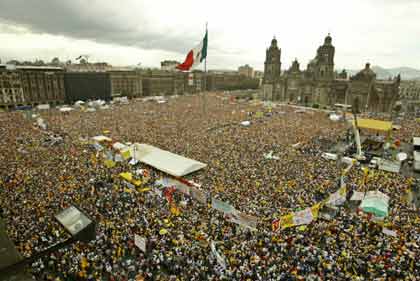
Below: A very large gathering of AMLO supporters--280,000 by official estimates--from La Jornada.


National mobilization called for this Wednesday.

Thanks to Lambert for the links, especially, via Mercury Rising, to the extremely detailed report on Narco News Bulletin, which raises some interesting questions about the process of counting votes.

Saturday, July 08, 2006

Uneven American Reporting on Mexico

I won't be the first to complain about the state of American journalism, especially reporting on foreign affairs. But I'm getting tired of the lazy job some--not all--writers are doing. Compare, for instance, today's updates on the Mexican presidential campaign from the Washington Post and the Los Angeles Times. The Post's Manuel Roig-Franzia emphasizes the emotional--the pent up rage of AMLO supporters "who were stoked into a sign-waving, fist-pumping frenzy by new fraud allegations that failed populist candidate" AMLO made at a rally in Mexico City's central square. The Post article also claims that AMLO is asking for a total recount of every vote cast, which is not the case.

In contrast, the LA Times leads with the PRD's strategy for contesting the electoral count. No they won't ask for a recount of every vote, only those in precincts with irregularities, although this adds up to about half of all the votes cast. Details, details. The point is that there is a rational strategy here, not just the pent up rage of the dispossessed. Oh yes, and Calderon is not the "president elect" yet. Not until the Federal Electoral Tribunal says so. This is clearly a complication most in the American press can't abide. In contrast, the Miami Herald's Mexican Edition (via El Universal) has the headline "Victory not final until judges verify results."

On the question of the cleanliness of the elections, the LA Times notes, "The election was monitored by hundreds of international observers, many of whom lauded the apparent orderliness of Sunday's vote. Some, however, did note irregularities during the official count of polling station reports that began Wednesday."

Calderon will fight the recount. Why? Because during the previous recount, in which about 2,500 precincts were recounted vote-by-vote (this according to the Post), his lead declined by half. Open another 2,500? Maybe it wouldn't matter, but why risk it.

Meanwhile, another interesting line on the election is the exporting of the American Red State-Blue State saw to Mexico. In the NYTimes, James McKinley notes the clear North-South split in the election with the modernized North voting for Calderon and the backwards, poor South voting for AMLO. If you've seen a map of how the Mexican states voted, the regional difference is pretty obvious, and you could see this comparison coming. But as with our own alleged red-blue split, when you paint the map by county rather than state things look much more mixed. Let's see how the maquilladora regions voted, for instance.

Friday, July 07, 2006

Waiting for the other shoe to drop

As expected the final word from the Mexican electoral commission's recount of precinct summaries found Calderon the winner by the razor thin margin of 0.58%. Look for a big, big, big rally Saturday around 5 PM in Mexico City in which AMLO stakes out his case against the election. The Electoral Tribunal does have the power to order the recount every single ballot, whereas the IFE could only open ballot boxes if there as evidence of tampering or problems with the tally sheets.

There are, of course, editorials on both sides. The most balanced American commentary seems to be coming from the Washington Post's Ceci Connolly's Campaign Connexion blog. No fear mongering there, and that's a relief. Surprisingly, the NYT called for a recount.

Meanwhile the US House and Senate are running hearings on immigration "reform," and Bush appears to be pushing for something before the November elections.

Thursday, July 06, 2006

Calderon squeaks ahead for now

With most of the precinct-by-precinct count finished, the conservative candidate is now ahead by a mere 0.39%, according to La Jornada. Lopez Obrador (a.k.a. AMLO) held a press conference this morning to say he will contest the count before the Federal Electoral Tribunal, and has called for a mass meeting in Mexico City this Saturday.

As in the past two American elections, the conservative "winner" and various media are calling for unity and worrying about how the lack of finality will damage Mexico's "young" democracy. There is a persistent implication in the American press that the PRD's challenge of the election is part of the long political hegemony of the PRI (i.e., the now discredited policies of the past) and the PAN's posture of defending the preliminary results signifies that it is the forward-looking defender of democracy. Unfortunately, this is closer to the PAN's campaign rhetoric than it is to reality. The Associated Press is helping all of this along with its "exclusive" interview with Calderon, which conveniently makes him sound presidential (he offered AMLO a place in his cabinet, called for calm, etc.).

In the American case we learned that the challenge of winning a closely contested election has less to do with counting the votes and more to do with staking out an unassailable public position of victory. Once you have achieved the latter, any effort to achieve the former plays as sour grapes or worse. But this isn't Florida or Ohio. So we shouldn't expect the outcome to be the same. Hold on for a bumpy ride, and our old democracy might learn a thing or two.

Update: Calderon's lead increased to 0.53% according to El Universal, which by the way loads more quickly and consistently than La Jornada. The LA Times is running a really good example of what I am complaining about in this post--treating the election as a done deal. But they also have a photo gallery with one image of AMLO supporters showing ballots allegedly found in a dump (see my previous post).

Wednesday, July 05, 2006

Americanization of Mexican Elections?

New developments in Mexico's presidential election, but still no winner declared. On Monday the Federal Election Commission clarified the preliminary count noting that several hundred thousand votes has not been counted toward the totals, although the precincts they came from were listed as counted. This shrank Calderon's lead to less than one percent and increased the pressure on the recount, which begins today.

American news reports indicated that Lopez Obrador was inclined to--much as Gore and Kerry did--allow the process to take its course. His supporters, on the other hand were mounting a campaign to pressure him to actively pursue the recount. The pre-election negative hype was that Lopez Obrador was a potential dictator who would tell the masses what to do. Now it seems the masses are dictating policy to their leader. This is certainly the crucial difference between US and Mexican political culture. The irony appears to be lost on American journalists who seem to view popular participation as evidence of Mexico's "young democracy." Maybe are ossified democracy has something to learn here?

Meanwhile, back at the dump....


Among the alleged irregularities turning up in the news is the story of 10 ballot boxes or precinct reports found in the trash in the state of Mexico. These were from PRD strongholds. The story is in Processo (spanish). More significant (numerically) is the discrpency of some 3 million votes between the number who voted for president and for legislative races.

With the formal Mexican campaign over, the Bush administration has let it be known that they are willing to compromise with House hardliners on an "enforcement first" immigration law. The idea would be, according to the NYT report, that citizenship and guest worker programs would only come into place after some specific "enforcement" goals are met. As predicted, the path toward compromise quickly takes us through the mud. Obviously, this was held back until the end of the election because it would have signaled the total failure of the PAN to effectively push immigration reform with the U.S.

Monday, July 03, 2006

Mexican Election Watch

For those of you waiting for information on the "too close to call" Mexican presidential election, as of Monday morning 10:10 AM the count is 36.4% for PAN and 35.41% for the PRD coalition. With 96.71% of the vote counted Lopez Obrador is still a down 377,893 votes. Calderon's lead has been declining little-by-little overnight. This will probably come down to 1) the location of the 3% uncounted precincts, and 2) whether or not evidence surfaces (and sticks) of foul play.

You can check the updated stats yourself on the site of the Instituto Federal Electoral. The other news source I'm watching is La Jornada's election coverage page. Of the U.S. papers, the Washington Post and the LA Times seem to have the more up-to-date information.

Greg Palast has an interesting post reporting on some Bush-style electioneering on the part of the PAN.

Update:
Apparently the IFE has stopped the preliminary count (Calderon still leading by 1%) and will begin a hand count Wednesday. Lopez Obrador, after first looking like he would accept defeat, is apparently bowing to grass-roots pressure to put up a legal challenge--this according to the SF Chronicle. The Washington Post has a good collection of "expert" posts followed by lots and lots of reader comments in their "Post Global" section. So far it seems like the readers are teaching the experts a lesson or two.

Friday, May 26, 2006

Senate Passes Immigration Reform, House Conservatives Snarl

With the US Senate finally passing their "comprehensive" immigration reform bill, we've moved a bit closer to a showdown between the ultraconservatives and pretty much everyone else. Somehow we're supposed to be happy that the House bill is "just a negotiating position." If that's the case, the Senate may already have given up too much. It is a sign of how crazy things are that the "pragmatic" approach calls for deporting around 1 million people.

But I'm nothing if not pragmatic. And I think it's worth reposting the statement of the Illinois Coalition for Immigrant and Refugee Rights on this matter:

With this bill (S 2611), the Senate has fundamentally recognized that our nation needs the hard work that immigrants perform; that mass deportations are both impossible and un-American; and that the only solution to our broken immigration laws is to reduce immigration backlogs, reunite families, and offer a path for undocumented immigrants to earn legal status and eventually become citizens.

As currently written, however, the Senate bill contains many unworkable and even counterproductive provisions:

· Creating three categories of the undocumented based on length of stay would leave millions of immigrants out of the process, subjecting them to harsh enforcement procedures that would drive them further underground and beginning the problem all over again, and would encourage massive document fraud.
· The 370 miles of border fence, costing $1 million a mile, would be an expensive and offensive symbol, one that would be particularly ineffective when 40- 45% of the undocumented in the U.S. arrive here legally with visas.
· Federalizing local police departments to enforce immigration laws would guarantee that immigrants will not report crimes or serve as witnesses.
· Eliminating judicial discretion and humanitarian exceptions to deportation cases would guarantee the brutal separation of families in the future.

The Senate bill now goes to a Conference Committee to be reconciled with the House bill, HR 4437. The bill could become substantially better--or substantially worse. As the Senate debate indicates, no workable reform can pass without a majority of Democratic support. We urge Speaker Hastert and the House Republicans to reach out to Democrats to craft a workable solution, and to ensure that the Conference Committee improves this bill. If the unworkable portions of the legislation are not fixed, then we will work to defeat it.

Thursday, May 11, 2006

Senate Moves on Immigration "Reform"

The LA Times is reporting that Republicans and Democrats in the US Senate have reached a compromise on immigration reform.  The key for Dems was the question of who would be on the Senate negotiating team when the bill goes into conference with the House's punitive bill that would make felons of undocumented migrants, their families, friends, and churches.

According to the Times Ted Kennedy says of his bill "Business and labor, Democrats and Republicans, religious leaders and
the American people strongly support our plan to strengthen borders,
provide a path to earned citizenship for those undocumented workers who
are here and put in place a realistic guest worker program for the
future."

As far as labor goes, that's not completely true.  The AFL-CIO opposes the Kennedy-McCain bill while Change to Win supports it.  Last weekend at the Labor Notes conference in Detroit I listened to a lawyer for the AFL-CIO explain their opposition, which boils down to 1) opposition to generalizing guest worker  programs beyond their traditional sectors (temporary agricultural work and high tech workers) and 2) the fact that the conference process with the House's bill will likely result in a really, really bad deal.

Other AFL-CIO and CtW representatives noted repeatedly that polls show that 60% of union members are opposed to liberalization of immigration laws.  Washington Post has an article to check out on immigrants who now favor strict immigration restrictions.
~~~~~~
Following up on the protests:  the Village Voice has a good collection of stories on immigration and the recent protests.  See their special sections tagged protest and immigration.
~~~~~~
In other news, turns out the NSA has been keeping tabs on all phone calls made in the US, not just international calls as previously admitted.  Prez. Bush, the valiant defender of civil liberties, is defending the program as a necessary antiterror measure. See reports in NY Times, Washington Post.

Thursday, May 04, 2006

Conservative Victim Mongering

Every once in a while I feel the need to read George Will.  Not sure why.  Parenting has really cut down my Sunday-morning political show watching, so I don't get my fix there anymore.  Just crazy, I guess.

Anywhoo, the odd title "Condescensional Wisdom" caught my eye today on the Washington Post site.  This ought to be interesting, especially since few are more condescending than George Will.  Well, what you get is a snide obit for economist John Kenneth Galbraith who died recently.  Galbraith was an advisor to JFK, and a "liberal" economist in the sense that he wasn't an apologist for capital (for a more friendly obit go here).  Unlike other economists, Galbraith seems to have actually known something about what it's like to be an actual person, not just a quantifiable abstraction.

So obviously, George Will isn't going to like him.  But do we really have to slag on the dead, George?  So what if William F. Buckley was a better downhill skier! (you have to read it)

What really struck me about this "opinion" piece is the following passage, referring to Galbraith and other critics of 1950s American advertising culture: 
"Americans were what modern liberalism relishes -- victims , to
be treated as wards of a government run by liberals. It never seemed to
occur to Galbraith and like-minded liberals that ordinary Americans
might resent that depiction and might express their resentment with
their votes."
Conservatives like to whip out the "liberals love victimhood" line.  And it ocurred to me as I read George Will do it for the gazillionth time that Conservatives actually like to be victims.  They nurture their sense that they are ordinary folk who have been wronged by elitist Liberals.  Please, George Will is not one of the ordinary folk.  This is just the latest version of the frontier narrative about hapless white settlers being attacked by vicious Indians (e.g., "Custer's Last Stand," a.k.a., the Battle of Little Bighorn).   Aggressors like to portray themselves as righteous victims.

I rant, I rant.

Tuesday, May 02, 2006

Day After M1: A Look at the Papers

Well the big day has come and gone.  Massive protests in LA, Chicago, New York.  A veritable general strike.  How's the media doing with it?  Not so well.

Maybe it's just naive to think that something as big as these protests will be the number one headline on NPR the next day.  After all, yesterday's noon NPR report was from Phoenix--reporting that the human chain demonstration there had been cancelled for "safety reasons."  That was it--nothing about the hundreds of thousands of people marching at that very moment in Chicago.

But still, I was a little shocked with this morning's 8 AM headlines on Morning Edition started with ... the resignation of Italy's Prime Minister!  Okay, sure, that's an important story, and it's good for American media to highlight international news.  But come on!  Perhaps a million people on the streets in one day?  Sorry, doesn't make the lead story.  Somebody at NPR is chicken.

So how are the online newspapers doing?  New York Times:  Berlusconi leads, immigrant protests below the "fold."  Washington Post:  Bird Flu is #1 story, immigrants #2 ("Although the protests caught the nation's attention, the economic impact was mixed, as many immigrants heeded the call of some leaders
not to jeopardize their jobs, and businesses adopted strategies to cope
with absent employees.").  Alternatively, Slate has a piece by historian Nelson Lichtenstein on the significance of May Day. 

The Chicago Tribune's front page downplays the march, but there is some content.  Eric Zorn's blog is a bit goofy.  He can't figure out what the immigrants want until he sees a 13 year old girl with a t-shirt that says "Don't Take Away My Dream."  He concludes, America is "a nation of laws, it's true, but we're also a nation of
dreams--the greatest such nation ever. And our laws should reflect that."  True enough.  The Trib's editorial is similarly middle of the road, calling on the Senate to act on "
the emerging American consensus on immigration reform"--i.e., some mix of crackdown, amnesty, and guest worker program.

Not surprisingly, the LA Times has the best coverage on the issue.  They lead with "Next Challenge:  Converting Protests to Political Clout."  And they have a series of photo galleries, and a series of related articles.

As usual, the best stories on on Indymedia sites.  LA Indymedia has great photographs, and an interview with the leader of the port truck drivers who claim to have organized a 90% effective strike.


The most bizarre thing I heard last night--did I hear this right?--Bush commented on the boycott saying something like "we don't want to lose our soul."  How's
that for antiworker opinion.  Go on strike, lose your soul.  Did anyone else hear that?

Saturday, April 29, 2006

May 1: As Close to a General Strike as We'll See in Our Lifetimes

Reviving a dormant tradition of the American labor movement, immigrant rights organizations are planning what reasonably can be called a General Strike for May 1st.  That's right, the same May 1st that marks the high point of the 19th century struggle for the eight-hour day.  The same May 1st that once marked the rememberence of Haymarket anarchists executed by the State of Illinois in 1889.  I won't dwell on the history, except to say that the history is suddenly perceived as more relevant to our present than it was even a year ago.

Instead, I point you to the Los Angeles IndyMedia site.  A quick review suggests that news of a split within the movement (between those advocating a boycott of work and those worried about backlash) seems to be oversold.  This is going to be a very, very big day of protest in LA, Chicago, and other cities.

Tellingly, the Chicago Police are saying that they will NOT be out in riot gear.  Unlike the paramilitary style that greets antiwar protesters, immigrant rights protests will be greeted as, dare I say it--citizens!  Significantly, the Chicago parade route will begin at Union Park (close to the Ashland Ave. cluster of union halls) and pass through Haymarket Square on its way to Grant Park.  The Chicago Federation of Labor will sponsor a rally at 4:30 PM on Monday at the Haymarket Monument.

If you are in Chicago: go, Go, GO! Take pictures, record sound and video. Talk to people. Gather the history of this important event.

Saturday, April 01, 2006

Culture Jamming in Progress


Apparently GM doesn't have enough trouble, what with laying off 30,000 workers and rumours of bankruptcy. Now the marketing geniuses at America's number 1 automaker have come up with the Chevy Apprentice contest, which asks you, dear consumer, to come up with your own commercial. What'll they think of next? Enlist us in our own brainwashing!


Well, not quite. Enjoy these until GM gets wise and deletes them. And by all means, make your own. I'll add new entries to this post as I get them.


  • Loretta (coming soon)


Update: looks like GM got wise to our little game. You can't email your video. But you can still create them for your own enjoyment and take screen shots.

Thursday, March 30, 2006

Welcome to the early 20th century

An interesting story via BBC today on the oil-rich United Arab Emirates (which includes Dubai, of recent US ports deal infamy). It seems the UAE has decided write a new set of labor laws that will for the first time make it legal for its mainly foreign workforce to unionize. This comes after Human Rights Watch called on the UAE to take immediate action to end abuse of migrant workers, and asked the World Bank to stop supporting projects in the country:
"During the past year, migrant workers have increasingly resorted to public protests and strikes in an attempt to improve working conditions. UAE government figures show that between May and December 2005, at least eight major strikes took place. The latest, in Dubai last week, quickly spread from construction workers who rioted at one skyscraper to others working on a new airport terminal."
The BBC report suggests this new law is aimed more at controlling strikes than helping workers. According to the UAE Minister of Labor:

"The law will control how strikes will be conducted. It will outline rights, the do's and don'ts.

"There will be a labour representative who will be our point of contact. It will make contact with the labourers much easier."

That's great. You're adopting legal concepts that were progressive in the early 20th century. But will you actually get the employers to pay their workers on time? How about modernizing workers' housing?

Read about the issue at Human Rights Watch here and here.

Wednesday, March 29, 2006

bugclub.blogspot.com is now bughouseblog.blogspot.com

Dear Readers: I have changed the url for this blog. You may now find Bughouse Square at bughouseblog.blogspot.com. Thanks for reading!

Sunday, March 26, 2006

The Next Civil Rights Movement is Here


"There has never been this kind of mobilization in the immigrant community ever. They have kicked the sleeping giant. It's the beginning of a massive immigrant civil rights struggle." So says Joshua Hoyt, executive director of the Illinois Coalition for Immigrant and Refugee Rights, quoted in today's Los Angeles Times.

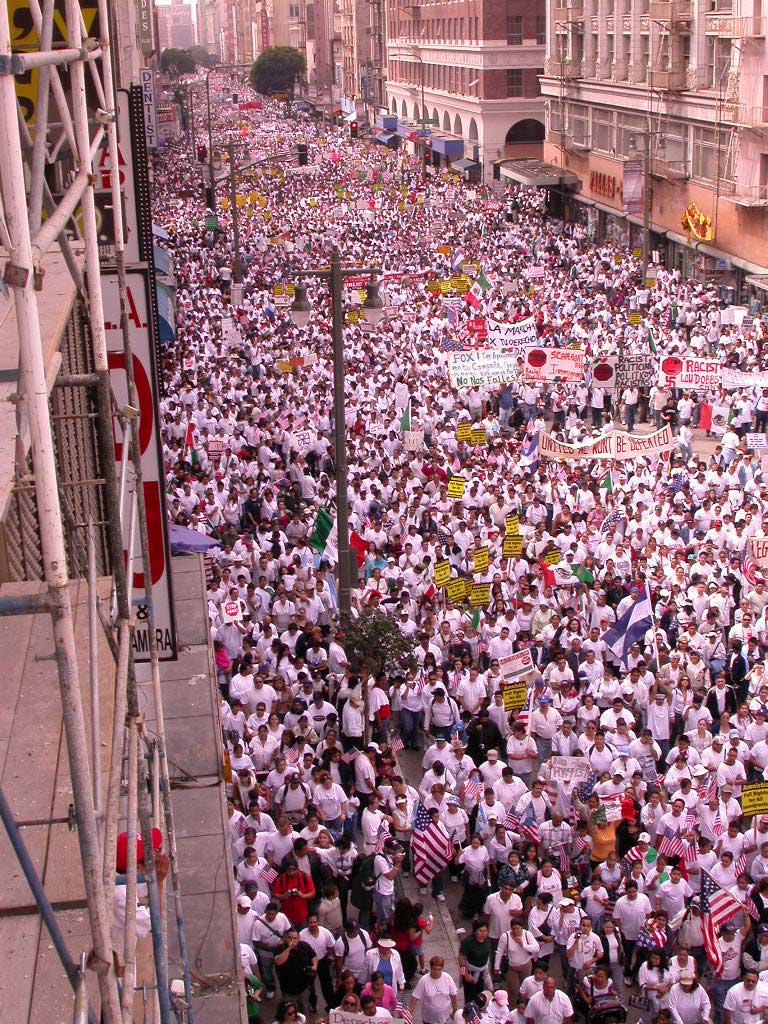
He was talking about the the massive demonstration in Los Angeles yesterday. According to police estimates there were 500,000 people in the streets of LA (and the police always underestimate these things) in favor of creating a path toward citizenship for the millions of undocumented workers already in the country. Two weeks ago more than 100,000 people turned out in Chicago for a similar protest, far surpassing in size the protests at the start of the Iraq War. In both cases, turnout was much bigger than organizers had hoped for. Demonstrations like these can change the political dynamic, spur others to action, and stiffen the backbone of wavering political allies.

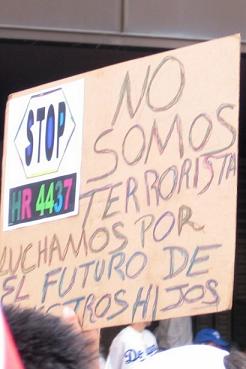
For coverage see the LA Times, which also has a good set of photographs from the rally. The LA Indymedia site has many more images, these taken from inside the march (the images in this post are from la.indymedia.org. LA Indymedia reports also give you a good sense of why so many people came out. The Sensenbrenner bill raises the image of thousands of people being summarily taken from their homes and jobs and deported.

Marc Cooper's blog has a good political analysis, which also points to an earlier Washington Post op-ed by Tamar Jacoby detailing why so-called "guest worker" programs ultimately will not work.

Tuesday, March 14, 2006

Tagging the Labor Web

The internet has loads of resources for labor activits, but the chaos of the net sometimes makes specific information hard to find. Try Googling "union." You get 507 million hits. It's enough to make you want to watch TV.

Lately people (including union activists) have been using a new tool called "social bookmarking" to identify and share useful websites. One of the most popular social bookmarking services is called Delicious, and it's free. (The url for the site is http://del.icio.us).

Del.icio.us and other social bookmarking services allow registered users to save links to websites in an online library. It's exactly like the Favorites list or Bookmarks folder on your web browser, but stored remotely so you can find it even if you use different computers (as long as all your computers are connected to the internet).

When you save a link, del.icio.us allows you to describe the link with keywords, or "tags." You can use as many tags as you like, and the service keeps track of all your tags so you can search your library. The service also lets you know how other people are tagging a particular link. You can search the entire del.icio.us link library on specific "tags" to see what other people with similar interests are looking at, and you can make combined searches by using a 'plus' sign between tags. For instance, to find labor union sites, search "labor + union," or "labor + union + blog" (If you only look for "labor" you get lots of sites about pregnancy).

Just imagine if thousands of union activists used del.icio.us and tagged every useful site "labor" and "union." Very soon we would have a good index of labor online. So go to it! I'm not the first or only person down this trail. The folks at Communicate or Die suggested a "labortech" tag a while ago (there are 72 sites tagged "labortech" on del.icio.us, compared with over 600 links using labor + union and 61 links for labor + union + blog).

You can do similar tagging with the image hosting site Flickr (http://www.flickr.com). Both Flickr and Delicious were recently purchased by Yahoo!

A word of caution, your del.icio.us library is completely public and visible to all other users of the service. This is a service that only works by sharing information freely. So use it with that in mind.

Saturday, January 21, 2006

NYC Transit Rank-and-File Reject Contract

From LabourStart and Bloomberg.com comes news that TWU local 100 members have rejected the tentative deal with the NY City transit authority. The vote was 11,234 to 11,227. That's right, it lost by 7 votes.

Back to the negotiating table for the union leadership and the MTA. But one thing is for sure, this is a sign of healthy democracy in the local.

LabourStart also links to a Reuters report that U.S. union membership is up for the first time in 6 years.