At 12 midnight and one second tonight, Felipe Calderon becomes President of Mexico, whether or not he is allowed to take the oath of office before a joint session of Congress tomorrow.
Suggested reading:
The Coup d'Etat in Mexico
Oaxaca: The End of Tolerance
Thursday, November 30, 2006


Tuesday, November 28, 2006
Oaxaca and New Media, Again
My readers will forgive me for being a bit behind the times: I've just discovered YouTube. Yes, I'm sure there's a lot of crap on it. But what is really interesting to me is how the images of the social conflict in Oaxaca are being repackaged, set to music, and sent out into the world with a very conscious message of international solidarity and organizing.
Todos Somos Oaxaca, to quote the title of one video--which was embedded in the home page of the southern Mexico newspapger Por Esto! this morning. This is set to a spanish-language hip-hop tune with the refrain "You won't fail if there's a beginning." A similar video montage is set to an English-language punk/hip-hop tune--"renegades of the atomic age"--that invokes the "renegades" of various ages--Tom Paine, Martin Luther King. Another is set to the music of Nirvana's "Smells Like Teen Spirit." Not a song I grew up with, but one my slightly younger spouse tells me was the "Twist and Shout" of her cohort.
What fascinates me about these videos--beside their visceral intensity, clever juxtaposition of image and sound, and powerful presentation--is that they are both artifacts of globalization and of an emergent counterhegemonic movement against neoliberal globalization. The reach of American muscial culture is evident. But two of these videos move from images of Oaxaca to protests in support of APPO in Europe, South and North America. The message emblazoned on the frame: what can you do to help us? Join us.
This past weekend there was a new, more intense round of violence in Oaxaca as Federal Police broke up a very large, and peaceful march. Nearly 150 people were arrested and flown to prisons in other states. NarcoNews reports that prisoners have been tortured. But almost nothing in the US press.
Todos Somos Oaxaca, to quote the title of one video--which was embedded in the home page of the southern Mexico newspapger Por Esto! this morning. This is set to a spanish-language hip-hop tune with the refrain "You won't fail if there's a beginning." A similar video montage is set to an English-language punk/hip-hop tune--"renegades of the atomic age"--that invokes the "renegades" of various ages--Tom Paine, Martin Luther King. Another is set to the music of Nirvana's "Smells Like Teen Spirit." Not a song I grew up with, but one my slightly younger spouse tells me was the "Twist and Shout" of her cohort.
What fascinates me about these videos--beside their visceral intensity, clever juxtaposition of image and sound, and powerful presentation--is that they are both artifacts of globalization and of an emergent counterhegemonic movement against neoliberal globalization. The reach of American muscial culture is evident. But two of these videos move from images of Oaxaca to protests in support of APPO in Europe, South and North America. The message emblazoned on the frame: what can you do to help us? Join us.
This past weekend there was a new, more intense round of violence in Oaxaca as Federal Police broke up a very large, and peaceful march. Nearly 150 people were arrested and flown to prisons in other states. NarcoNews reports that prisoners have been tortured. But almost nothing in the US press.
Saturday, November 11, 2006
Local Struggles, Global Symbols
 The American election results made the headlines in Mexico, even if US media have for the moment forgotten not only about Oaxaca, but the rest of the world as well. Cautiously welcoming the Democratic victory, Mexicans hope for a more nuanced, less strident discussion on immigration and "border security."
No doubt there will be a change in tone from the US Congress. The Illinois Coalition for Immigrant and Refugee Rights (ICIRR), cheers the election as well, headlining: "IMMIGRATION FAILS AS WEDGE ISSUE FOR GOP" citing a survey of election results from Immigration 2006.
"Our preliminary analysis of last night’s results strongly suggest that very few toss up races were won by Republican candidates who attempted to exploit immigration as a voter motivator. Democrats that back comprehensive immigration reform mostly won their races. And the Republican Party is likely to get smaller as its hard line on immigration drives away Hispanic voters."A bit over optimistic to my way of thinking. But the new political landscape in Washington will make a difference. We will probably see the new leadership move to pass the previously-stalled "comprehensive" reform package that includes amnesty for some, deportation for more than a million, and a guest worker program that will cycle millions of disenfranchized workers in and out of the US economy. The guest worker program is favored by Bush and leading Dems (it is supported by SEIU, but opposed by AFL-CIO), so it's an obvious choice for those seeking to prove their bipartisan cred.
I am not so sure that guest workers will go down well with the American workers who just put the Dems in office, and that dynamic will be interesting to watch. Take a quick look at what union folks are complaining about at the Fox Valley Labor News: the spectre of a Canada-US-Mexico superstate that would throw out the US Constitution. This conspiracy theory is being pushed by a group of ultra-right wingers, and it came up among a group of Steelworkers I taught last summer.
If the Democratic leadership simply pushes the Kennedy immigration bill for swift passage, I think it will backfire. Instead, the Dems would be wise to foster an honest dialogue on immigration, free from the shrill racism, jingoism, and demogogery of the last few years. After that, maybe we can have new laws, new programs.
Back in Oaxaca, the fire burns on and Ulises Ruiz's hold on office gets more tenuous. No doubt he's just holding on until December 1st. If he resigns before then, there will be a new election--which the PRD will probably win. After December 1st, the PRI-PAN alliance can name a replacement.
There is a very nice analysis by Laura Carlson of the International Relation Center that takes in the whole situation and its relation to neoliberalism, free trade and globalization. This is one of those rare articles that is measured, historically informed, and forward looking. And this is what inspires the title of my post:
And why does this strike me so today? Because I'm reading James Green's excellent new book on nineteenth century American class society, Death in the Haymarket so I can teach it to a group of union leaders. (If you need a quick version of the Haymarket story, go to the Encyclopedia of Chicago). As a historian who lived in Chicago for five years, I have to admit I had grown a little tired of Haymarket. After a few hundred retellings, it gets old. But if it lost something in the telling, the story has always captured something visceral in me whenever I have encountered one of the spaces and memorials of the event.If the movement for global justice were a territorial battle, Oaxaca would be a tiny point on a very large map, of little consequence except to the people involved. But symbolic battles, although very real for the combatants themselves, are the true terrain of the movement for global justice. They offer an opportunity, even when lost, to defeat the myths that uphold the system.
Green sets the story of the bombing in Chicago's Haymarket Square on May 4, 1886, within a rich context of immigrant working class life and class warfare that took on an intensely personal character even as it symbolized wider struggles. The Chicago anarchists certainly understood the symbolic, and they saw themselves as part of a trans-Atlantic, if not quite global, movement. And ironically, over time the Chicago martyrs became much more known outside of the US than they were inside.
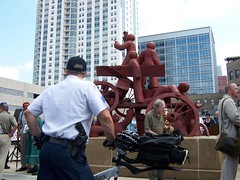
As Oaxaca is today, Chicago in 1886 was a local conflict on the cutting edge of "globalization." A very different form of globalization, and a different form of struggle, but both are local struggles with global symbolism.
In a sense, the two came together last May 1st when a huge march of immigrants--largely Mexicans and other Latin Americans marched through Haymarket Square. The new, powers-that-be-approved memorial wasn't the focus of the march, as it was of the CFL-sponsored labor day rally later the same day. But it was also more than just something passed along the way. The organizers clearly understood the symbolism of May 1st, and they chose their path to connect their struggle with the Chicago martyrs.
These are my rather jumbled thoughts on this, November 11, the anniversary of the hanging in Chicago of Albert Parsons, August Spies, Adolph Fischer, and George Engel in 1887.
Tuesday, November 07, 2006
The Oaxaca Movement and New Media
Nancy Davies has a very interesting analysis of the impact of new media on the social movement in Oaxaca in the NarcoNews Bulletin. In brief, widespread use of digital cameras, independent online sources like NarcoNews, LaJornada, and others, and the APPO's ability to hang on to control of Radio Universidad has closed off many of the traditional strategies of the repressive PRI governor. As independent news sources persist and proliferate, it becomes impossible for the governor to use agents provocateur, and to blame state-sponsored violence on the movement.
An excerpt:
An excerpt:
In addition, camera and video brigades, of foreign and national journalists, have arrived in force. Everything gets shown, leaving the PRI and URO with no place to hide. Local movement people carry cameras and when an attack is threatened Radio Universidad sends out a call for everybody to come with video cameras and still cameras, to document what is happening –as they did with the June 14 attack on the zocalo. Each helicopter overhead shows up in a photo. URO’s ability to lie about who has the weapons and who shot whom, has been destroyed. Every video and every still, furthermore, finds its way onto the internet, the international news, the national news, the local news –all the way down to the streets where the videos play on screens perched on boxes on the sidewalk, for every passerby to see.This, as much as anything, explains why the PFP wanted to close down Radio Universidad. And their failure may signal the end for Ulises Ruiz and the PRI precisely because it was captured by independent media and is being replayed again and again on the streets of Oaxaca and across the globe.
Friday, November 03, 2006
PFP Attacks University in Oaxaca
I was out of touch for one day and lots has happened. Just some quotes from other sites, since there's no time to summarize--have to cut my 20 page paper down to 10 in the next hour and a half.
From Nancy Davies
From Nancy Davies
According to George Salzman, later in the morning as PFP confronted ranks of mostly young male protesters, the protesters threw rocks, homemade missiles and molatov cocktails at the police:The War is On in OaxacaThe war is on in Oaxaca. It began at 8:00 AM with the gathering of the PFP and an infiltration by porros (hired thugs) along with state police in plain clothes. There are 5,000 PFP and many people if they're out there. The Rector of the university has called for unity and denounced the federal gov't. The University is an autonomous community. The radio is calling for pacific resistance but since the feds are using tear gas the people are pissed off and the report is that they are starting to use rocks and sticks. Several people have been arrested and wounded, including three children. A helicopter is there and presumably may airlift people to the airport for getting them into custody.
Posted on Thu Nov 2nd, 2006 at 01:06:16 PM EST
When one of the projectiles hit the ground and burst into flame in front of the first line of troops a wave of adrenaline swept the protesters, many of whom ran forward and hurled rocks at the police. I’ve written a lot about the teachers and APPO maintaining a militant but non-violent struggle, which I remain convinced is correct. But this was a different matter: this was people trying to protect their own turf from being invaded by lethally-armed forces, and there’s no way the attempted defense could be described as non-violent. Had the police been ordered to shoot, it could have been a massacre. All that can be said is that the imbalance of power was incomparably in favor of the police; had it been used, it would have been overwhelming.And from El Universal/Miami Herald this moring:
Will check in tomorrow.Along the avenue, opposite the campus, a mid-day soccer game in progress came to a grinding halt, but the players paused only for a moment before they scurried to find rocks and join the protesters in throwing them at the police from the field.
Men and women pushed shopping carts filled with rocks up toward the front line. They shouted to those coming from surrounding streets to bring rocks. An elderly woman advanced into the clouds of tear gas offering water that had been blessed by a local priest to the students.
The police were forced back, but only to open the way for a coordinated attack by riot tanks and their water cannons - with water laced with pepper spray.
Inside the university grounds, protesters coordinated brigades to rush Coca-Cola and vinegar, their remedy for the immediate burn of tear gas, out to the protesters. Announcers inside the university radio station called for supporters to bring food, water, and Coke to the university.
The battle then turned into chaos. The PFP drove their tanks up and down to disperse the crowd; three military helicopters flew overhead firing tear gas grenades. The protesters rushed the police and the tanks with thick volleys of rocks and then ran back to take cover and wash their burning faces in Coke.
By late afternoon hundreds more had joined the protesters, pushing the police back from the university, capturing a riot tank and setting it aflame. Two helicopters flew over, dropping tear gas grenades, but too late: at 3 p.m. the PFP were in full retreat.
Late Thursday night, APPO spokesman Florentino López said 55 protesters had been detained by the PFP.
Subscribe to:
Posts (Atom)

